Trane AC Installation in Encino, CA
Direct take: Encino Trane HVAC installs right-sized Trane air conditioners across Encino, CA (91316 and 91436), from a single-stage XR16 on an Encino Village ranch to a variable-speed XV20i in an Amestoy Estates rebuild. Call (213) 277-7557 or book online for a Manual J load calc, the permit, and HERS verification, with central replacements running $5,000 to $12,000.
Worth knowing
- Central AC replacement (condenser + coil): $5,000-$12,000 typical 2026 SoCal range.
- Trane tiers installed: XR single-stage, XL two-stage, XV18 and XV20i variable-speed.
- Manual J load calc on every job; we do not copy the old oversized nameplate.
- A Climate Zone 9 install carries the permit, the refrigerant-charge check, and HERS duct verification.
- Service area: Encino Hills, Amestoy Estates, Royal Oaks, South of the Boulevard, Encino Village, Lake Encino.
- Independent shop; in-warranty units referred to Trane authorized service first.
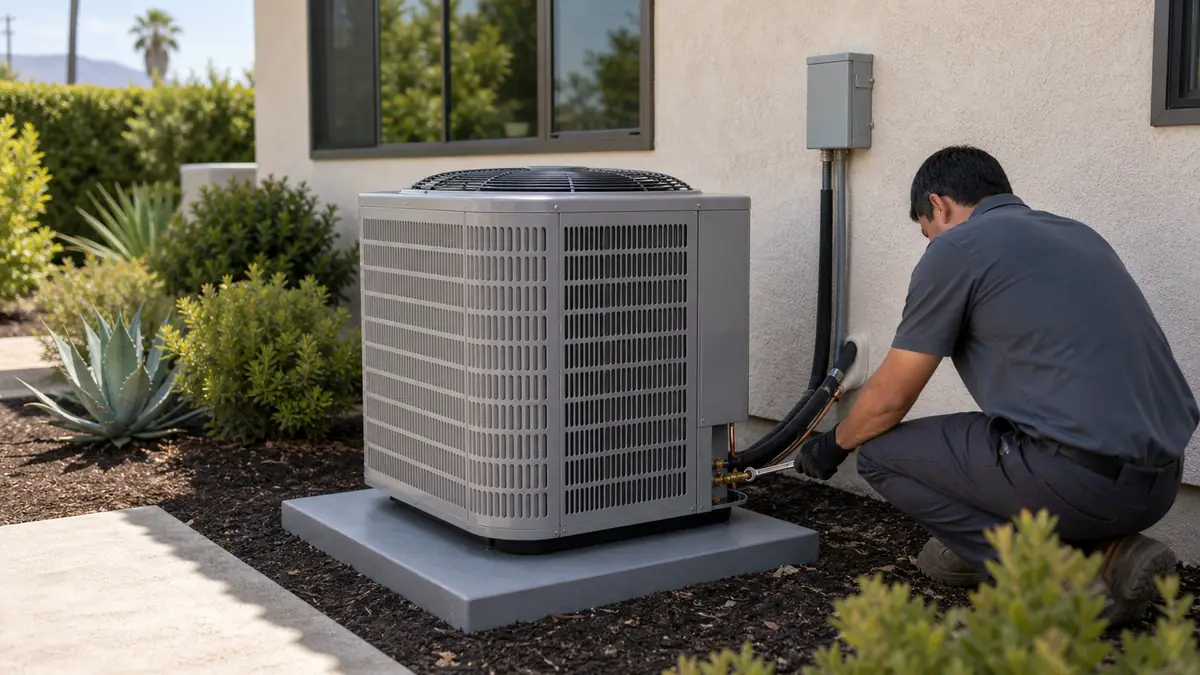
Why is AC installation different on Encino estates?
Encino's lots are big and its houses are bigger. The sprawling single-story ranch estates near Los Encinos State Historic Park were built for one or two central systems, and the luxury Mediterranean and modern rebuilds want zoned comfort across two or three floors. A like-for-like swap off the old nameplate usually carries forward a decade of oversizing, which short-cycles the compressor and leaves humidity and hot spots behind.
We start with a Manual J load calculation that accounts for the home's orientation against the Santa Monica Mountains, the glazing on those big estate windows, insulation, and real duct losses. In Climate Zone 9, where July highs hit 92 to 96 F and the valley holds heat into the evening, a properly sized Trane condenser run on tight ducts is the difference between a system that coasts and one that runs flat-out all afternoon.
Which Trane AC tier fits your home?
Trane's air-conditioner lineup runs from the value XR single-stage workhorses up to the variable-speed XV20i flagship. The right pick depends on your footprint, your duct condition, and how tightly you want to hold temperature. Here is how the tiers map to Encino homes.
| Trane tier | Best fit in Encino | Typical installed range |
|---|---|---|
| XR13 / XR14 / XR16 single-stage | Flatland ranch held at one temperature; budget replacement | $5,000-$8,500 |
| XL-series two-stage | Mid-size home wanting quieter, steadier cooling | $7,500-$10,500 |
| XV18 variable-speed (4TTV8) | Two-story rebuild, tighter humidity control | $9,000-$12,000 |
| XV20i variable-speed (4TTV0/5TTV0) | Large multi-zone Encino Hills estate, up to ~20.5 SEER2 | $10,000-$14,000 |
The XV tiers use the Climatuff variable-speed compressor and require a ComfortLink II XL824 or XL850 control to unlock full modulation. Pair the wrong thermostat and a premium variable-speed unit runs like a single-stage. Read the full breakdown in our Trane buying guide for Encino.
What components matter most on a new system?
The Climatuff compressor is the heart of the unit, and on XV models it modulates capacity for tighter temperature control. The all-aluminum Spine Fin outdoor coil resists corrosion and has fewer leak points than copper fin-tube designs, which matters on long SoCal service life. Indoors, a variable-speed ECM blower paired with a properly matched evaporator and a correctly sized TXV is what actually delivers the rated efficiency.
Get any one of those wrong and the install underperforms: an oversized coil with a mismatched blower, a TXV hunting on a low charge, or a single-stage thermostat throttling a variable-speed compressor. We commission every install by verifying refrigerant charge and measured airflow, not by trusting the box rating.
How does a Trane AC install actually go?
An install is a sequence, not a swap. Each step has a reason, and skipping one is where a premium system quietly underperforms.
- Manual J load calculation. We measure orientation against the Santa Monica Mountains, glazing, insulation, infiltration, and duct losses to size the tonnage. The old nameplate is a starting clue, not the answer, since it is usually oversized.
- Equipment and coil match. We pair the condenser with a matched evaporator coil, a correctly sized TXV, and the right ECM blower so the system hits its rated SEER2.
- Permit and Title-24 paperwork. We file the permit and pre-book the third-party HERS rater for the Climate Zone 9 verifications.
- Set, braze, and pressure-test. We set the condenser on a level pad, braze the line set under flowing nitrogen to keep the copper clean, and pressure-test for leaks.
- Evacuate and weigh in charge. We pull the system into a deep vacuum to remove moisture, then weigh in the R-410A to the manufacturer target rather than guessing by gauge pressure alone.
- Commission and verify. We confirm measured airflow, superheat and subcooling, and on an XV20i we check the XL850 is staging the Climatuff compressor through its full modulation range.
That last step is the difference between an install that meets its label and one that drifts. Shortchange a new Encino condenser on either charge or airflow and it quietly gives back tonnage and the SEER2 number you paid extra for, afternoon after afternoon, with nobody the wiser until the bills land.
What does a new AC cost in Encino, and why?
A central AC replacement runs roughly $5,000 to $12,000 in the Encino area in 2026, and the spread is real because the work behind each number differs. Here is how the band breaks down by the sub-jobs that drive it.
- Equipment tier ($3,500-$9,000 of the total). An XR16 single-stage condenser and matched coil sit at the low end; an XV18 or XV20i variable-speed system with a ComfortLink II control sits at the high end.
- Line set and electrical (varies). Reusing a sound line set is cheaper; a long run to a hillside pad, a new disconnect, or a panel circuit adds cost.
- Duct condition. If the 1960s ranch ducts are leaky or undersized, sealing or partial replacement is an add-on, often $800 to $3,100, so the new tonnage actually reaches the registers.
- Permit, HERS verification, and crane access. Climate Zone 9 verification fees and, on some Encino Hills lots, equipment access all factor in.
We quote each piece so you see what your number is buying. A like-for-like XR changeout on a flat Royal Oaks lot is the low lane; a zoned XV20i on a multi-story rebuild with new ducts is the high lane.
Does Title-24 affect my Encino install?
It does. Encino sits in Title-24 Climate Zone 9, a cooling-dominant zone, so a new or replacement split system normally calls for refrigerant-charge and airflow verification, and altering most ducts pulls in HERS field verification of the sealing. The DOE Southwest-region floor for a split AC under 45,000 BTU stands at 14.3 SEER2 right now, and we set equipment at or above it. We file the permit and book the third-party HERS rater so your install clears inspection with no snags.
Common questions about AC installation in Encino
What size Trane AC does a typical Encino ranch need?
It depends on a Manual J load, not square footage alone. A well-insulated 2,000 square foot Encino Village ranch often lands near 3 to 3.5 tons, while a leaky 1960s home with single-pane glass can need more. We measure orientation, glazing, and duct losses rather than copying the old nameplate, which is frequently oversized.
Should I install a single-stage XR or a variable-speed XV20i?
For a modest flatland ranch held at one temperature, an XR16 single-stage is efficient and affordable. For a two-story Encino Hills rebuild with a hot great room and cool bedrooms, the variable-speed XV20i on ComfortLink II modulates capacity and holds tighter temperatures, which is worth the premium on big footprints.
Do I need new ductwork when I replace the condenser?
Not always, but on 1950s and 1960s Encino homes the original ducts are often undersized and leaky. A new high-SEER2 condenser pushing air through restrictive ducts will trip the high-limit and underperform. We test static pressure first and recommend duct sealing or replacement only when the numbers call for it.
How long does an AC install take in Encino?
A straight condenser-and-coil changeout on a single-story Amestoy Estates or Royal Oaks home is usually one day. Adding ductwork, a multi-zone layout, or a new ComfortLink II thermostat and HERS verification pushes it to two or three days, including the inspection and charge verification.
What does Title-24 require for a new AC in Encino?
Encino sits in Climate Zone 9, so a replacement split system usually needs refrigerant-charge and airflow verification, and altering most ducts pulls in HERS field verification of the sealing. We file the permit and line up the third-party rater so the job clears inspection.
What is the SEER2 minimum for a new AC in Encino?
California sits in the DOE Southwest region, so a split-system AC under 45,000 BTU has to clear 14.3 SEER2 / 11.7 EER2, and 13.8 SEER2 at 45,000 BTU and up. We set equipment at or above that floor; an XR16 meets it, an XV20i reaches roughly 20.5 SEER2 for the upper rebate tiers. Confirm the current code cycle before quoting.
Can you replace just the condenser, or do I need a matched coil?
On most Encino changeouts we replace the condenser and the indoor evaporator coil as a matched pair. A new high-SEER2 Trane condenser run against an old, mismatched coil loses rated efficiency, hunts the TXV, and can ice up. Matching the coil and a correctly sized TXV is what actually delivers the tonnage and efficiency on the box.