Trane Error Codes in Encino, CA
Direct take: A Trane furnace in Encino, CA (ZIP 91316 or 91436) reports faults as an LED flash count on its control board, where four flashes is an overheat limit and five flashes is a flame-sense fault, so call Encino Trane HVAC at (213) 277-7557 or book online and we read the code on site.
Worth knowing
- The code is an LED blink count on the integrated furnace control.
- Four flashes = open high-limit. Five flashes = flame sensed when none expected.
- A code that returns after a reset is a real fault, not a glitch.
- Gas, rollout, and overheat codes get a same-day visit in Encino.
- Most repairs land between $150 and $900; gas valves run higher.
- Service area: Encino Hills, Amestoy Estates, Royal Oaks, Encino Village, Lake Encino.
How do you read a Trane error code?
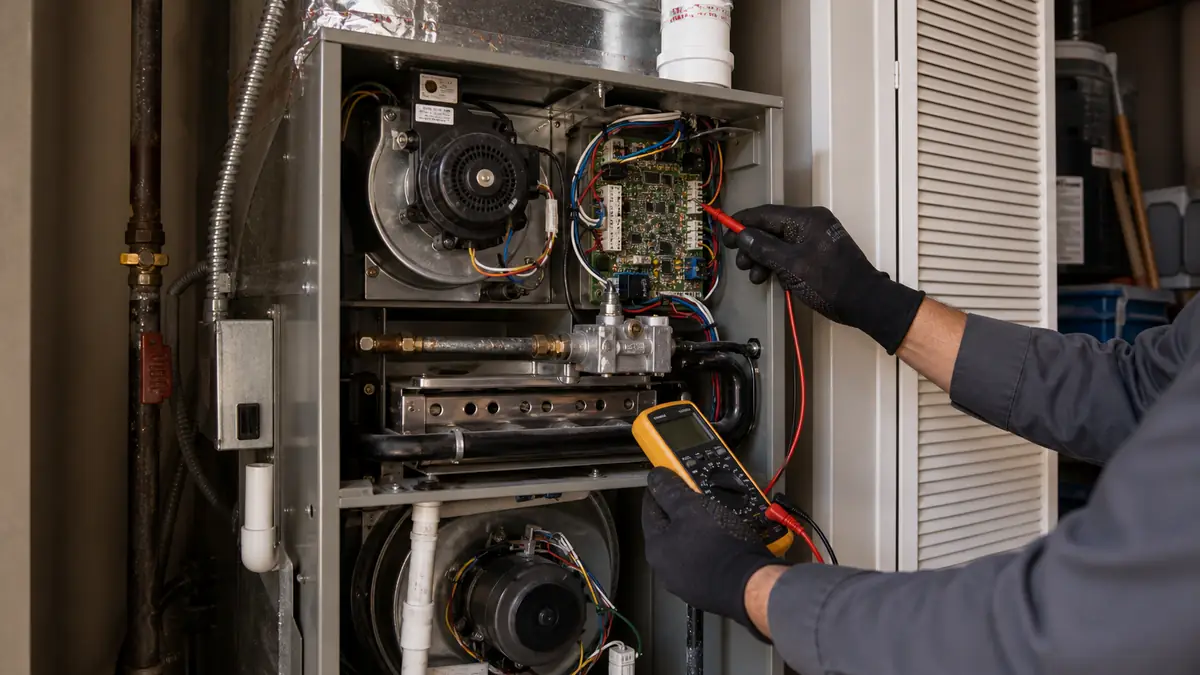
A Trane furnace does not show a number on a screen. It blinks one. A single LED on the integrated furnace control flashes a count, pauses, then repeats. The count is the code. Watch through the sight glass on the burner door, or pull the lower panel to see the board directly.
Count the blinks in one group. Two blinks is a system lockout. Four blinks is an open high-limit. The legend is printed on the inside of the furnace panel. We work from that legend, not from memory, because a variable-speed S9V2 or XC95m board can add codes a basic XR80 does not have. The flash count tells you where to look. It does not tell you which part failed. That part still takes a meter to confirm.
What does each Trane flash code mean?
This table is the one we work from on Encino furnaces. It covers the common two through nine flash codes on the Trane and American Standard integrated control family. A slow steady blink is normal standby. A fast blink is a normal call for heat. Anything else is a fault.
| Flash code | Meaning | First check |
|---|---|---|
| 2 flashes | System lockout after too many ignition retries | Igniter, flame sensor, gas supply |
| 3 flashes | Vent or pressure-switch error, draft not proven | Inducer, blocked flue, pressure switch |
| 4 flashes | Open high-temperature limit, furnace overheated | Dirty filter, restrictive ducts, blower |
| 5 flashes | Flame sensed when no flame should be present | Gas valve leak-by, control board |
| 6 flashes | Reversed 115VAC polarity or poor ground | Line wiring after a panel change |
| 7 flashes | Gas-valve circuit error | Gas valve or its wiring |
| 8 flashes | Low flame-sense signal | Dirty or corroded flame sensor |
| 9 flashes | Igniter circuit or 24V common fault | Hot-surface igniter, control wiring |
Two of these codes are the ones we field most in Encino, and each has its own deep page. The Trane 4 flashes page walks through an open high-temperature limit. The Trane 5 flashes page covers a flame sensed when none should be present, which is a gas-safety code we do not reset and walk away from.
Why do Trane furnaces throw codes in Encino homes?
Encino sits in Title-24 Climate Zone 9, a warm Mediterranean valley against the Santa Monica Mountains. Winters are mild. That shapes the failures we see. A furnace that runs lightly for a few months a year sits idle the rest. Idle parts corrode. The flame sensor builds an oxide film. The hot-surface igniter goes brittle. The first cold morning calls on all of it at once, and the board logs a code.
Housing matters too. Encino runs to mid-century ranch, sprawling single-story estates, and new luxury rebuilds south of the Boulevard. The ranch homes hide furnaces in tight hallway closets and low attics where filters get skipped, which starves airflow and trips a four-flash limit. The rebuilds carry zoned, variable-speed systems where a comm or board fault reads differently than on an old XR80. Same brand. Different failure profile by house. We read the home as much as the code.
How do you diagnose a Trane code on site?
We start at the board. We confirm the flash count and the legend, then power-cycle once to see if the fault is hard or intermittent. From there the meter comes out. A four-flash overheat means we measure temperature rise and external static pressure to prove the airflow restriction. A flame-sense code means we read the sensor in microamps; below roughly two microamps the burner drops out. An igniter code means we read the element resistance, usually 40 to 90 ohms when healthy.
Gas codes get a manometer on the valve to read inlet and manifold pressure. A five-flash flame-when-none-expected gets the most caution, because it can mean a gas valve leaking by, which is a safety condition, not a convenience fault. We never clear a code and leave. We clear it, watch a full cycle, and confirm the reading holds before we call the furnace fixed.
How do we fix the common Trane codes, and what does it cost?
Most code fixes are mid-range, not the worst-case number people fear. An open high-limit from airflow is a filter, a coil cleaning, or a duct correction, roughly $150 to $600; a failed limit switch runs about $150 to $350. A dirty flame sensor is a clean or replace, about $150 to $400. An igniter is a similar $150 to $400. A control board lands near $400 to $900 installed.
Gas-side work runs higher: a gas valve is typically $300 to $700. We quote the cause, not the code, because the same flash count can have a cheap or an expensive root. If the furnace is old and the heat exchanger is suspect, that conversation shifts to our repair-or-replace guide. For the hands-on repair itself, our furnace repair page lists the work and the rates.
Common questions about Trane error codes in Encino
Where do I read the flash code on a Trane furnace?
Look through the small sight window on the furnace door, or pull the lower panel. A single LED on the integrated furnace control blinks a count. Count the blinks between pauses. That count is the code. Two blinks is one fault, four blinks is another. The control board legend printed on the inside panel maps each count to a meaning.
Is a Trane furnace flashing a code dangerous?
It depends on the code. A four-flash high-limit or a five-flash flame-sensed-when-none-expected can point to a heat or gas-safety condition, so we treat those as urgent. A simple dirty-flame-sensor lockout is not an emergency but stops your heat. Any code tied to gas, rollout, or overheating gets a same-day look from us in Encino.
Can I clear a Trane error code myself?
You can reset one fault safely: cut power at the furnace switch for 30 seconds, then restore it. Replace a dirty filter while the power is off. If the same code returns, the cause is still there. A code that comes back after a reset is a part or airflow problem, not a glitch, and needs a meter to find.
Do all Trane furnaces use the same flash codes?
Most modern Trane and American Standard gas furnaces share the same LED flash table, since they use the same integrated furnace control family. Older units and variable-speed S9V2 or XC95m boards can show extra codes for the ECM blower. We confirm the exact legend on the panel of your specific unit before we act on a count.