Frozen Evaporator Coil in Encino, CA
Direct take: A Trane evaporator coil that ices over in Encino, CA (91316 and 91436) almost always means restricted airflow or a low refrigerant charge, not a cold-weather fluke. Call Encino Trane HVAC at (213) 277-7557 or book online; we thaw the coil, find the airflow or charge cause, and fix it, commonly on Encino Hills systems with clogged filters.
Worth knowing
- Two main causes: restricted airflow and low refrigerant charge.
- First aid: shut off cooling, run the fan to thaw, replace the filter.
- Running an iced coil risks liquid refrigerant damaging the Climatuff compressor.
- Airflow fix $95-$350; leak repair + recharge $225-$1,500; ECM blower $450-$2,300.
- Melting ice can trip a float switch or overflow the condensate drain pan.
- Service area: Encino Hills, Amestoy Estates, Royal Oaks, Lake Encino.
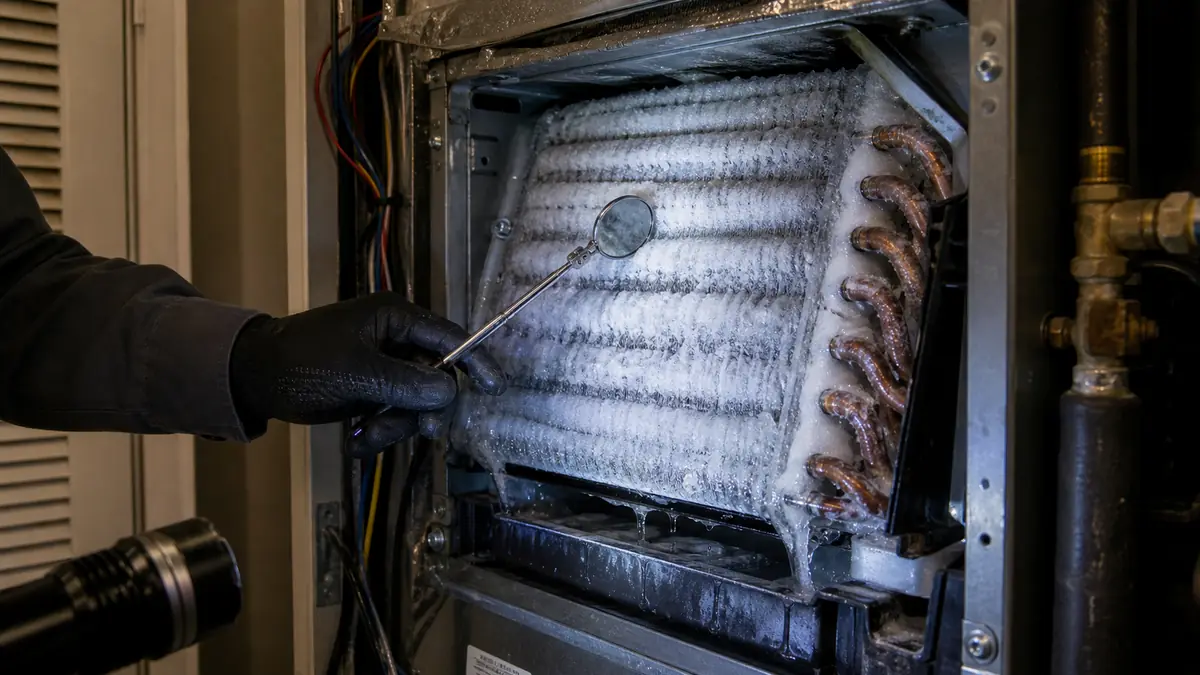
Why does a coil freeze when it is 95 F outside?
It seems backwards, but a coil freezes precisely because it is not getting enough warm air across it. The evaporator coil works by absorbing heat from the air the blower pushes through it. Choke that airflow with a clogged filter, a dirty blower wheel, or a closed-off return, and the coil temperature drops below freezing. Condensation on the fins turns to frost, the frost builds to ice, and now you have a block of ice where you need a heat exchanger.
The other cause is low refrigerant. A leak in the all-aluminum Spine Fin coil or the line set drops the pressure, which lowers the coil's boiling temperature below freezing even with normal airflow. Both paths end the same way: the cold air stops, the system keeps running, and water pools when the ice melts. In Encino, summer filter neglect on big ranch systems is the number-one trigger.
What should you do right now?
- Turn cooling off. Switch the thermostat from cool to off so the compressor stops.
- Set the fan to ON. The blower will move air across the coil and thaw it, which can take an hour or more.
- Replace the filter. A clogged filter is the most common airflow restriction.
- Do not keep cooling. Running an iced system can slug liquid refrigerant into the compressor and cause expensive damage.
Once it thaws you may get cooling back for a while, but if the cause was a leak or a failing blower, it will freeze again. The thaw buys time, not a fix.
How do you diagnose the underlying cause?
| Clue | Likely cause / first check | Cost lane |
|---|---|---|
| Filthy filter or dirty blower wheel | Airflow restriction | $95-$350 |
| Weak cooling before icing, oily residue | Low charge from a Spine Fin or line leak | $225-$1,500 |
| Blower weak or intermittent | Failing ECM blower motor or module | $450-$2,300 |
| Water at the air handler, float trips | Clogged condensate drain or pump | $120-$450 |
After the coil thaws, we measure airflow and check the charge with gauges, looking at superheat and subcooling. A low charge plus an oily smudge means a leak we need to find and seal, not just top off. A weak ECM blower shows up as low static airflow even with a clean filter. If airflow at the registers is generally poor, our weak airflow page covers the duct side.
What is safe to check yourself, and what needs a pro?
A frozen coil has a short list of safe homeowner steps and a clear line where the work becomes ours.
- Safe to do yourself: switch cooling off and the fan to ON to thaw the coil, swap a dirty filter for a clean one of the same size, open any closed supply registers, and clear furniture or rugs off return grilles. These restore airflow and cost nothing.
- Call a pro for: anything involving refrigerant, gauges, or opening the sealed system. A low charge means a leak, and adding refrigerant without finding the leak is illegal venting and a temporary fix. Repeated freezing after a clean filter, oily residue at a joint, or a blower that labors all point to work that needs instruments and an EPA-certified tech.
The honest rule: if a fresh filter and a full thaw do not keep the coil clear for more than a day, stop running it in cool mode and book a diagnosis before you risk the Climatuff compressor.
Common questions about frozen coils in Encino
Why is my Trane evaporator coil frozen in summer?
Ice on the indoor coil during a heat wave is almost always restricted airflow or low refrigerant. A clogged filter or dirty blower starves the coil of warm air, so it drops below freezing and condensation turns to ice. A low charge from a Spine Fin coil leak does the same thing. The cold air stops, and water pools when the ice melts.
What should I do the moment I see ice on the coil?
Turn the cooling off and set the fan to ON so the blower can thaw the coil, and replace a dirty filter. Do not keep running it in cool mode; a frozen coil can slug liquid refrigerant back to the compressor and damage it. Then call us, because the ice is a symptom of airflow or charge, not the actual fault.
Will a frozen coil damage my Trane system?
It can. Running a system with an iced coil risks liquid refrigerant returning to the compressor, which is a leading cause of compressor failure. The melting ice can also overflow the drain pan and trigger a float-switch shutoff or water damage. That is why we treat a frozen coil as a stop-and-diagnose situation.
How much does it cost to fix a frozen coil in Encino?
It depends on the cause. A filter and a coil cleaning to restore airflow is the low lane, around $95 to $350. A refrigerant leak repair and recharge runs $225 to $1,500, and a failed ECM blower motor restricting airflow can run $450 to $2,300. We diagnose the underlying cause before quoting.