Trane Furnace 5 Flashes in Encino, CA
Direct take: Five flashes on a Trane furnace in Encino, CA (ZIP 91316 or 91436) means flame is sensed when none should be present, a gas-valve leak-by or control-board safety fault, so call Encino Trane HVAC at (213) 277-7557 or book online and shut the gas off at the furnace cock until we arrive.
Worth knowing
- Five flashes = flame sensed when no flame should be present.
- Common cause: a gas valve leaking by its seat, or a control-board fault.
- It is a safety code; we treat it as urgent, not routine.
- If you smell gas, leave and call the gas utility before anything else.
- A control board runs about $400 to $900; a gas valve $300 to $700 or more.
- Service area: Encino Hills, Amestoy Estates, Royal Oaks, South of the Boulevard.
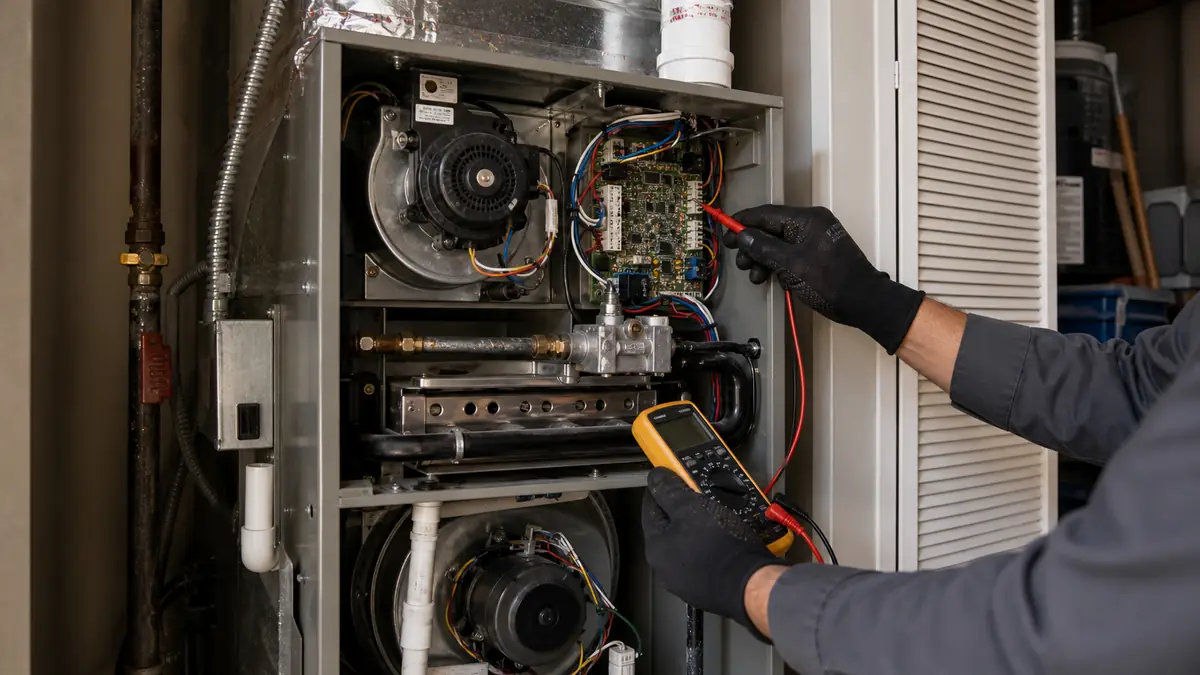
What does 5 flashes mean on a Trane furnace?
Five flashes has a precise meaning. The control sees flame when there should be none. During startup, between cycles, or after the gas valve closes, the flame-sense circuit should read no flame. When it reads flame in that window, the board flashes five and locks the furnace out.
There are two real causes. The first is a gas valve that leaks by its seat. The valve is supposed to seal shut. If it passes a trickle of gas, that gas can ignite or stay lit on the burner when the furnace should be off, and the sensor correctly reports flame. The second is the control board itself, reading a phantom flame signal on a degraded flame-sense input. The code is the same. The fix is not. One is a gas part. One is electronics. We do not guess between them.
How is 5 flashes different from a normal lockout?
Most Trane lockouts are about too little flame. A two-flash lockout is the furnace failing to light after retries. An eight-flash code is a dirty flame sensor reading too few microamps. Those are starvation faults: the furnace wants flame and cannot prove it.
Five flashes is the opposite, and that is why it carries more weight. The furnace is seeing flame it did not ask for. A starvation fault leaves you cold but safe. A flame-when-none-expected fault means gas may be reaching the burner outside the controlled sequence, which is a combustion-safety problem. We sort it into the urgent column the moment we read the count, ahead of a routine no-heat call.
Why does this code show up on Encino furnaces?
Encino furnaces sit idle most of the year. Climate Zone 9 here is a mild Mediterranean valley pressed against the Santa Monica Mountains, so heating runs only a handful of months. A gas valve that sits closed and unused for three seasons can develop a seat that no longer seals perfectly when it is finally called on in winter. Light duty is not the same as easy duty on a valve.
The housing stock adds its own wrinkle. Many South of the Boulevard and Encino Hills homes are luxury rebuilds with newer high-efficiency furnaces and sensitive integrated boards, where a marginal flame-sense ground or a moisture-touched connector throws a phantom reading. The older ranch furnaces in Encino Village run simpler valves that wear at the seat instead. Same five-flash code, two different root causes by house age. We read the equipment before we read the part.
What should you do right now, and what is safe?
This code has a short safe list, and a clear line you should not cross.
- Do this safely: if you smell gas, leave the house and call your gas utility from outside first. If you do not smell gas, turn the furnace off at its switch and close the manual gas cock at the furnace. Then book a diagnosis. Shutting it down is the right move.
- Do not do this: do not keep resetting the furnace to force it to run. Each reset on a flame-when-none-expected fault risks letting gas reach the burner uncontrolled. Do not open the gas valve or the burner assembly. That is metered, certified work.
The honest rule here is different from a no-heat code. With five flashes, the safe default is off, not on. A cold night is an inconvenience. A leaking gas valve left running is not.
How do you diagnose and fix a Trane 5 flash code?
We separate the gas valve from the board with instruments. First the manometer goes on the valve to read inlet and manifold pressure and to watch whether the valve holds zero manifold pressure when it is commanded closed. A valve that shows pressure when it should read nothing is leaking by, and it gets replaced. Gas valve work runs about $300 to $700 or more with labor.
If the valve seals correctly, the fault is electrical. We meter the flame-sense circuit and the board's flame input, check the sensor ground, and look for a corroded connector or a moisture path that feeds a phantom signal. A board that misreads the circuit gets replaced, roughly $400 to $900 installed. We also inspect the heat exchanger and rollout switches, because anything touching combustion gets a full safety look on this code. We confirm the furnace runs a clean, controlled cycle before we leave. For the full code list, see our Trane error codes hub; for the repair itself, our furnace repair page covers the work, and the repair-or-replace guide helps if the furnace is old enough to weigh replacement.
Common questions about a Trane 5 flash code in Encino
What does 5 flashes mean on a Trane furnace?
Five flashes means flame is sensed when no flame should be present. The control sees a flame signal during a period when the burner is off. That almost always means a gas valve is leaking gas by its seat and a residual flame is lingering, or the control board is misreading the flame circuit. Either way the board locks the furnace out, because uncontrolled flame is a safety condition.
Is a Trane 5 flash code an emergency?
Treat it as one until proven otherwise. A gas valve that leaks by lets gas reach the burner when the furnace should be off, which is the kind of fault that gets a same-day visit in Encino. If you smell gas, leave and call your gas utility first. If you do not, shut the furnace off at its switch and at the gas cock, and book a diagnosis. Do not keep resetting it.
Can a dirty flame sensor cause 5 flashes?
Not usually. A dirty flame sensor causes the opposite problem: it fails to see flame that is there, which shows as an eight-flash low-signal code or a lockout. Five flashes is the reverse, flame seen when none is expected. That points at the gas valve seat or the board's flame-sense circuit, not a fouled sensor. We meter the circuit to tell which one.
How much does a Trane 5 flash repair cost in Encino?
It splits by cause. If the control board is misreading the flame circuit, a board runs about $400 to $900 installed. If the gas valve is leaking by its seat, a valve replacement is higher, often $300 to $700 or more with labor. We confirm which part is at fault with a manometer and a meter before we quote, because a board and a gas valve are very different repairs.