Trane Furnace 4 Flashes in Encino, CA
Direct take: Four flashes on a Trane furnace in Encino, CA (ZIP 91316 or 91436) is an open high-temperature limit, meaning the furnace overheated and shut off on its safety, almost always from restricted airflow, so call Encino Trane HVAC at (213) 277-7557 or book online and we find the airflow fault instead of just resetting it.
Worth knowing
- Four flashes = open high-limit. The furnace ran too hot and tripped its safety.
- Cause is usually airflow: a clogged filter, dirty blower, or choked ducts.
- First homeowner step: replace the filter, open registers and returns.
- Airflow fix about $150 to $600. A failed limit switch $150 to $350.
- Repeated overheating can crack a heat exchanger, a safety replacement.
- Service area: Encino Hills, Amestoy Estates, Royal Oaks, Encino Village.
What does 4 flashes mean on a Trane furnace?
Four flashes is one thing: an open high-temperature limit. The furnace got too hot. A bimetal limit switch opened to cut the burner. That is a safety, working exactly as designed.
The limit sits in the supply air stream above the heat exchanger. It watches plenum temperature. When the air leaving the furnace climbs past its setpoint, often around 160 to 200 degrees depending on the model, it opens and kills the gas. The burner stops. The blower keeps running to clear the heat. Once the plenum cools, the limit closes and the furnace tries again. If the heat keeps stacking up, it trips again, and the board logs the four-flash code. The switch is rarely the problem. The heat behind it is.
Why does a Trane furnace overheat in Encino homes?
It overheats because air is not moving through it. A gas furnace makes a fixed amount of heat. The blower has to carry that heat away. Slow the air and the heat exchanger runs hotter and hotter until the limit opens. Almost every four-flash call in Encino is an airflow story.
Encino's housing makes the pattern worse. The mid-century ranch homes around Encino Village and Amestoy Estates tuck furnaces into tight hallway closets and shallow attics. Filters there get forgotten for a year. A one-inch filter caked with valley dust chokes the return. The sprawling single-story estates run long duct branches to far bedrooms, and a collapsed flex run or a closed-off room starves the system. The mild Climate Zone 9 winter hides it: the furnace runs little, so nobody notices the restriction until the first real cold snap loads it and the limit trips on the coldest morning of the year.
How do you diagnose a Trane 4 flash code?
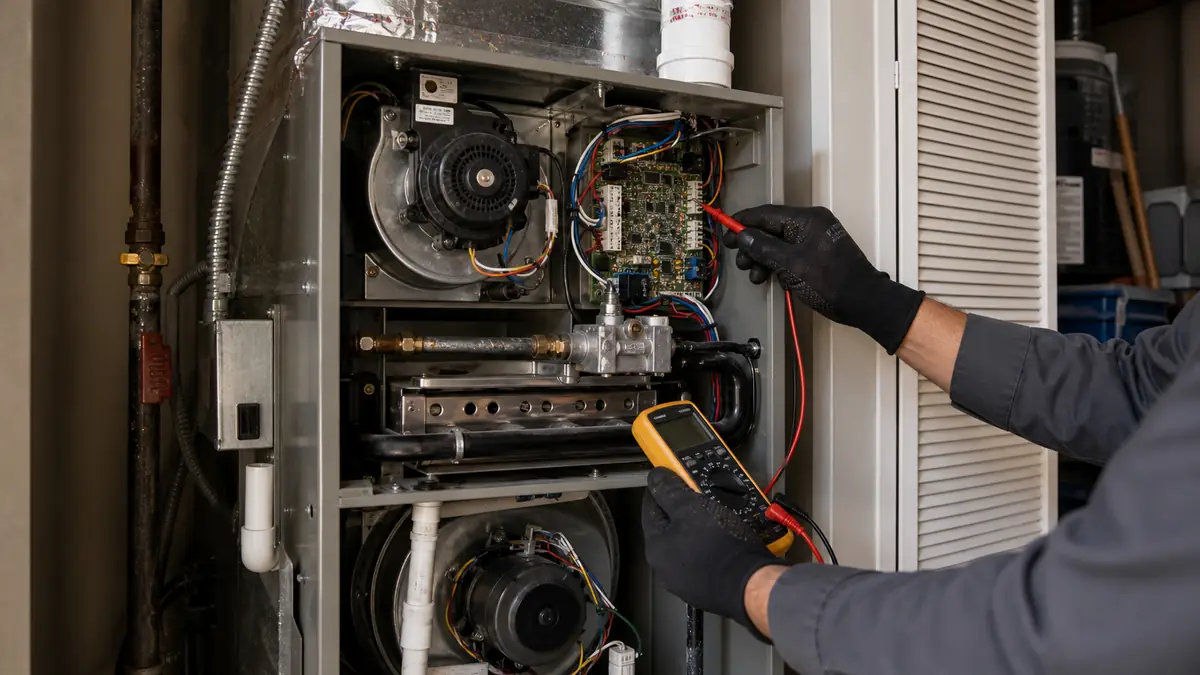
We prove the airflow with numbers, not a guess. The core reading is temperature rise: the supply air temperature minus the return air temperature. Every Trane furnace stamps a rise range on its rating plate, commonly 35 to 65 degrees. We put thermometers in the supply and return plenums and read the difference across a full cycle.
- Temperature rise. A reading above the plate range proves the air is moving too slowly. That is the overheat.
- External static pressure. We put a manometer across the air handler. High static confirms a restriction and tells us where, on the return or the supply side.
- Filter and coil. We pull the filter and inspect the evaporator coil and blower wheel for dust loading.
- Blower. We confirm the blower or ECM is spinning to its commanded speed and that the wheel is clean.
- Limit switch. Only after airflow checks out do we test the limit itself for continuity, in case the switch is weak.
The readings name the cause. A high rise with high return-side static is a filter or return-duct problem. A high rise with a clean filter points at the blower, the coil, or the supply ducts. We fix what the meter shows.
What can you safely check before you call?
The airflow side has safe homeowner steps. The heat side does not.
- Safe to do yourself: shut the furnace off at its switch, replace the filter with the same size, open every supply register, and clear furniture or rugs off return grilles. Restore power and watch one heat cycle. These restore airflow and cost almost nothing.
- Call a pro for: anything past airflow. Reading temperature rise and static pressure needs instruments. Testing the limit switch, inspecting the heat exchanger, and clearing a dirty blower wheel are our work. A four-flash code that returns after a fresh filter means the restriction is deeper or the switch is failing.
One rule. If the furnace keeps tripping the limit after you change the filter, stop running it and book a look. Repeated overheating is what cracks a heat exchanger.
When is a Trane 4 flash code urgent, and what does it cost?
It is urgent when it repeats. A single trip on a dirty filter is routine. A furnace that short-cycles on the limit again and again is cooking its heat exchanger, and a cracked heat exchanger leaks combustion gas into your air. That is a carbon-monoxide risk. We inspect the heat exchanger on any Encino furnace that has been overheating, and we do not just reset and leave.
On cost: an airflow fix, a filter, a coil cleaning, or a duct correction, runs about $150 to $600. A failed high-limit switch is roughly $150 to $350. A control board, if the limit circuit reads fine but the board is misfiring, lands near $400 to $900. A cracked heat exchanger moves the conversation to replacement; see our repair-or-replace guide. Most four-flash calls, though, end at a clean filter, a cleared coil, and a furnace that holds its temperature rise. For the broader code map, our Trane error codes hub lists every flash count, and our furnace repair page covers the hands-on work.
Common questions about a Trane 4 flash code in Encino
What does 4 flashes mean on a Trane furnace?
Four flashes is an open high-temperature limit. The furnace got too hot and the limit switch opened to shut off the burner as a safety. It is almost always restricted airflow, not a broken switch. A clogged filter, a dirty blower wheel, or choked ductwork lets heat stack up in the heat exchanger until the limit trips. The switch did its job.
Can I fix a Trane 4 flash code myself?
You can try the airflow side. Cut power, replace a dirty filter with the same size, and open every supply register and return grille. Restore power and watch one heat cycle. If the four-flash code clears and stays clear, a filter was starving the furnace. If it returns, the restriction is deeper or the limit switch is weak, and that needs a meter and a static-pressure reading.
Is a Trane 4 flash code dangerous?
It is a safety trip, so the furnace is protecting itself, but you should not ignore it. Repeated overheating stresses the heat exchanger, and a cracked heat exchanger is a carbon-monoxide risk. If the furnace short-cycles on the limit again and again, stop running it and book a diagnosis. We check the heat exchanger any time a furnace has been overheating in Encino.
How much does a Trane 4 flash repair cost in Encino?
It depends on the cause. An airflow fix, a filter, a coil cleaning, or a duct correction, runs about $150 to $600. A failed high-limit switch is roughly $150 to $350. If the overheating cracked the heat exchanger, that is a replacement conversation, not a repair. We quote after we measure temperature rise and static pressure, not before.