Trane XR-Series Air Conditioners in Encino
Direct take: Encino Trane HVAC services Trane XR-series air conditioners across Encino, CA (91316 and 91436), the single-stage Climatuff workhorse most common on Encino Village and Amestoy Estates ranch homes. Call (213) 277-7557 or book online to repair XR13, XR14, and XR16 condensers or install a right-sized replacement, which runs about $5,000 to $8,500.
Worth knowing
- XR family: XR13, XR14, XR15, XR16, XR16 Low Profile, XR17 single-stage AC.
- Built on the Climatuff compressor and all-aluminum Spine Fin coil.
- Most common failure: dual-run capacitor ($150-$450), then contactor.
- Non-communicating, so diagnosis is electrical; no numeric outdoor code.
- New XR install runs roughly $5,000-$8,500 in the Encino area.
- Service area: Encino Hills, Royal Oaks, Lake Encino, South of the Boulevard.
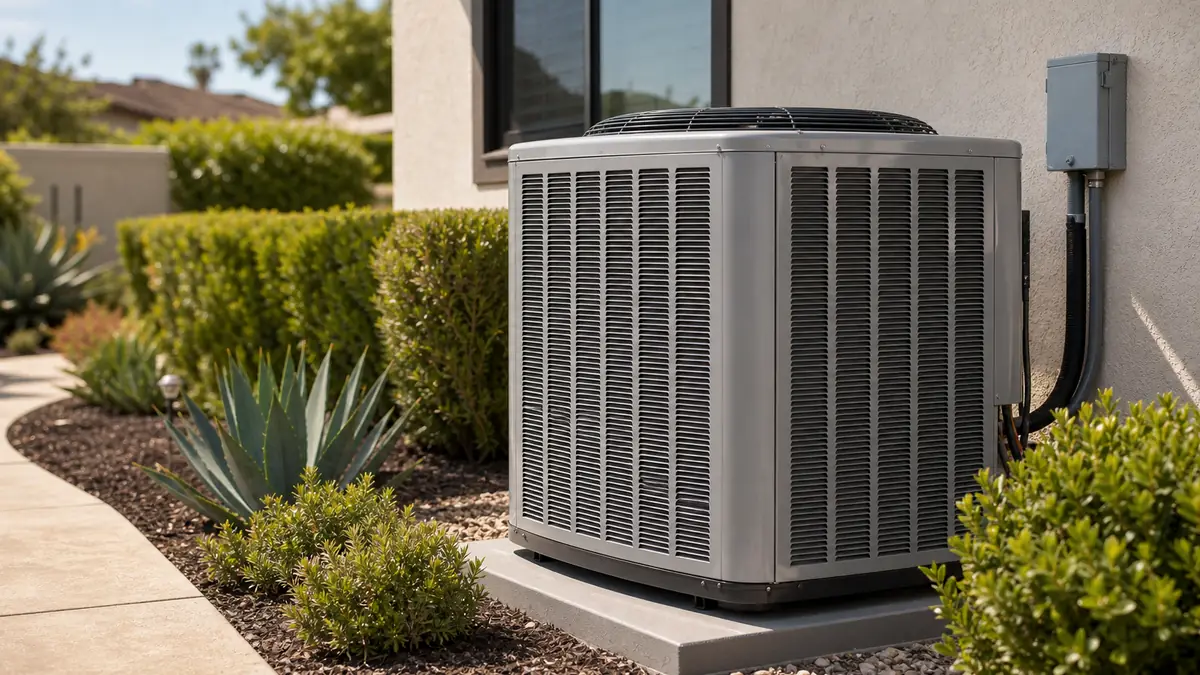
What is the Trane XR series, and why is it common in Encino?
The XR line is Trane's value, single-stage air-conditioner tier: the XR13, XR14, XR15, XR16, the XR16 Low Profile, and the XR17. They run the same Climatuff compressor and all-aluminum Spine Fin coil as the premium units but in a fixed-speed, durable, widely stocked package. For a single-story Encino ranch that holds one temperature across the day, that simplicity is a feature, not a compromise.
Encino's flatland ranch stock near Los Encinos State Historic Park is full of XR-class equipment because it was the sensible choice for a one-zone home. The trade-off is comfort precision: a single-stage unit is either fully on or off, so it cannot modulate down for a mild afternoon the way a variable-speed XV can. On a big two-story rebuild that matters; on a 1,800 square foot ranch it usually does not.
XR model-by-model: which one is on your pad?
The XR line spans several models that share the Climatuff compressor and Spine Fin coil but differ in efficiency and size. Knowing which is outside helps set expectations on parts and replacement.
| Model | What it is | Best fit in Encino |
|---|---|---|
| XR13 / XR14 | Older, lower-SEER2 single-stage value units | Budget like-for-like ranch replacement |
| XR15 | Mid value single-stage | Small to mid single-zone home |
| XR16 | Higher-SEER2 value workhorse, the common pick | Most single-story Encino Village ranch homes |
| XR16 Low Profile | Reduced-height cabinet, same single-stage class | Tight side-yard or screened equipment areas |
| XR17 | Top of the single-stage XR range | Efficiency-minded one-zone replacement |
All of them are non-communicating, so the outdoor unit posts no numeric code and the diagnosis is electrical. The XR16 Low Profile is worth flagging for Encino: on lots where the condenser sits in a narrow side yard against a wall, the shorter cabinet can be the difference between a clean set and a clearance headache.
What breaks on an XR condenser, and what does it cost?
| Symptom | Likely cause / first check | Cost lane |
|---|---|---|
| Hums but compressor or fan dead | Failed dual-run capacitor | $150-$450 |
| Clicks, intermittent no-start | Pitted or welded contactor | $150-$450 |
| Weak cooling, ice on indoor coil | Low charge (Spine Fin leak) or dirty coil | $225-$1,500 |
| Furnace flashes 4 on a cooling call | High-limit trip from low airflow | $95-$600 |
| No start, breaker trips | Grounded or seized compressor | $1,200-$3,500 |
Because XR units are non-communicating, there is no plain-language alert to read; we meter the capacitor, inspect the contactor, and check superheat and subcooling. If you are seeing ice on the coil, our frozen evaporator coil page walks the causes.
How do you diagnose a no-cool XR in the heat?
During a 95 F Encino afternoon, the most likely culprit is the dual-run capacitor. We test its microfarad rating against the nameplate; a capacitor that has drifted low or bulged cannot give the compressor the start torque it needs, so the unit hums and trips on overload. Next we inspect the contactor for pitting, since arcing burns the contacts and causes intermittent starts.
If the electrical side checks out but cooling is weak, we move to refrigerant: a low charge from a Spine Fin coil leak or a dirty condenser coil restricting heat rejection. We confirm with gauges and temperature splits rather than just topping off refrigerant, because a refill on a leaking XR buys a few weeks of cold and then drains right back down to where it started.
What does installing an XR involve in an Encino home?
On Encino's mid-century ranch stock, an XR replacement is usually a clean swap, but two things decide how smooth it goes. First, the ducts: those 1950s and 1960s homes often have undersized, leaky runs, and a fresh XR16 pushing air through a restrictive system trips the furnace high-limit and short-cycles the compressor. We read static pressure before we set equipment. Second, Climate Zone 9 verification: a replacement split system normally needs refrigerant-charge and airflow verification, and altering ducts pulls in HERS field verification of the sealing. We pull the permit and book the rater so the job clears inspection.
Sizing is the other quiet trap. The old XR on the pad is frequently oversized off a decades-old rule of thumb, and carrying that tonnage forward leaves humidity and hot spots behind. We run a Manual J load instead of copying the nameplate, which on a typical 1,800 to 2,000 square foot Encino ranch often lands at 3 to 3.5 tons rather than the 4 tons someone guessed in 1985.
XR versus XL and XV: where is the line?
The honest comparison is about modulation, not brand prestige. An XR is single-stage: the Climatuff compressor runs fully on or fully off. An XL is two-stage, so it can run a quieter, steadier low stage on mild days. An XV18 or XV20i is variable-speed, modulating capacity continuously on a ComfortLink II control to hold temperature within a tight band and pull more humidity.
For a flatland Encino ranch held at one setpoint, that modulation buys little, so the XR is the right-sized, lower-cost answer and the dollars are better spent on sealing the ducts. On a 4,000 square foot Encino Hills rebuild with a hot great room and cool bedrooms, single-stage cycling shows up as uneven comfort, and the XV tier earns its premium. The XL sits in between for a mid-size home that wants steadier cooling without the top-tier cost.
When should an XR be replaced instead of repaired?
On single-stage units the age-and-cost rule lands cleanly. A 6-year-old XR16 that wants a capacitor is an obvious repair. A 15-year-old XR13 that wants a compressor is a replace, since pouring $1,200 to $3,500 into a unit near the end of its life rarely pencils out when a fresh system runs $5,000 to $8,500 and carries a new warranty and better SEER2. We hand you the math during the visit. See the repair-or-replace guide for the full framework and the AC installation page for replacement options.
Common questions about Trane XR air conditioners in Encino
Is the Trane XR series good enough for an Encino home?
For a single-story Encino Village or Royal Oaks ranch held at one temperature, yes. The XR16 single-stage on the Climatuff compressor is a durable, affordable workhorse that handles Climate Zone 9 cooling well. Where the XR falls short is a large multi-story rebuild that wants zoned, modulated comfort, which is XV territory.
What is the most common XR-series failure here?
The dual-run capacitor, by a wide margin. SoCal heat cooks capacitors, and a swollen or out-of-spec capacitor leaves the compressor humming but not starting. It is a $150 to $450 same-visit fix. The pitted contactor is the runner-up, and the two are often replaced together.
Does the XR series have fault codes I can read?
Non-communicating XR units like the XR13, XR14, and XR16 do not post numeric codes; diagnosis is electrical. The connected furnace or air handler may flash a four-count LED if it trips the high-limit on low airflow. If you pair an XR with a communicating thermostat the alerts are limited, since the unit itself is single-stage.
How long should a Trane XR air conditioner last in Encino?
With annual service and a clean coil, 12 to 16 years is realistic in this climate, though hard summer runtime on an oversized or duct-starved system shortens that. The all-aluminum Spine Fin coil resists corrosion and has fewer leak points, which helps longevity on long SoCal service life.
What is the difference between an XR16 and an XR14?
Both are single-stage Climatuff condensers; the difference is efficiency and stocked features. The XR16 carries a higher SEER2 rating and is the common mid-value pick, while the XR14 and XR13 are the lower-cost, lower-SEER2 options. All three run fully on or off, so none modulate the way a variable-speed XV does. We match the model to your footprint and budget at quote time.
Should I replace my XR with another XR or step up to an XV?
For a single-story Encino ranch held at one temperature, another XR16 is the efficient, affordable choice and pairs with a simple thermostat. Stepping up to an XV18 or XV20i only pays off on a larger, multi-zone home where modulation balances hot and cool rooms. We size with Manual J and tell you honestly whether the XV premium earns its keep on your home.